When Facts Are Not Enough
What thirty years of medicine taught me about changing minds

Margaret is a sixty-three year old patient I have known for years. She is a sharp woman, a retired high school teacher who spent decades persuading teenagers that reason and evidence are important. She votes carefully. She reads widely. She is, by any measure, precisely the kind of patient who should be easy to treat.
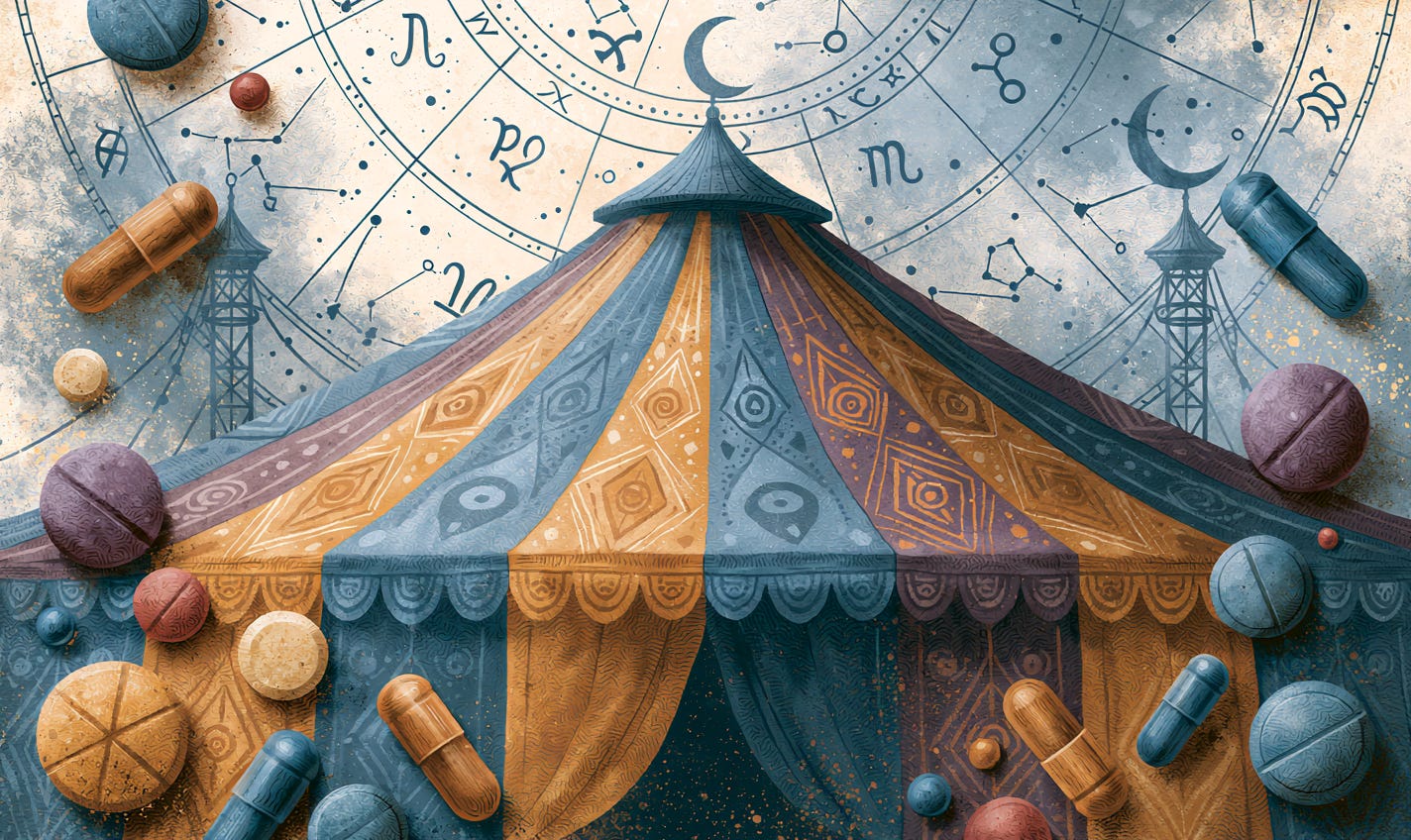
Last week, when in for a routine blood pressure review, she placed a paper bag on the counter with a small, defiant ceremony. Inside were seven supplements: collagen powder, high-dose vitamin C, “adrenal support” capsules, something called ‘Gut Harmony’, two different magnesium preparations, and a coral calcium tablet that cost, I later looked it up, sixty-two dollars for a month’s supply.
She wanted to know if I had any concerns.
I had several. But I began, carefully, with the coral calcium. There was no good clinical evidence it did anything a cheap store-brand calcium supplement couldn’t do. The “adrenal support” capsules, I explained contained licorice root at a dose that might interact with her antihypertensive. The collagen powder was being digested into amino acids like any other protein and was, at best, an expensive way to consume a small amount of glycine. I tried to be gentle. I tried to be precise. And I tried to be correct.
Margaret listened with the polite patience of someone waiting for you to finish being wrong. Then she told me about a woman from her walking group, Janet, who had been struggling with fatigue and joint pain for years before discovering the same collagen supplement. Janet now walked ten kilometres on Saturdays. She told me about a podcast she trusted, run by a former nurse, who had explained that mainstream medicine was decades behind the research. She told me about an account she followed on Instagram, a woman in Vancouver with a hundred thousand followers. She told me that her daughter, who worked in wellness, had done a lot of reading on this.
She left with her blood pressure medication adjusted and her supplement bag intact.
I thought about Margaret all week. Although her case was not unusual – in fact it is remarkable common – I thought about her because she unsettled my own certainties. Here was an intelligent, educated, critically-minded woman, and she was paying sixty-two dollars a month for ground-up coral. And she was not confused about it. She was ‘convinced’.
After thirty years of general practice, I have learned that facts are only part of the reason people believe what they believe. And changing a person’s mind requires more than simply giving them better information.
I. The Stars Have Always Had Something to Say
Astrology is a useful starting point for exploring the enduring appeal of implausible beliefs systems. While it is one of the most familiar belief paradigms in modern culture, its central claims have been tested repeatedly and have not held up well. The position of the planets at birth does not appear to determine personality, predict relationships or explain the course of a human life.
Yet astrology continues to feel persuasive to millions of intelligent, educated people.
That makes it more than a harmless curiosity. Astrology provides a compact demonstration of the several cognitive biases that allow unrealistic beliefs to remain persuasive.
Yet every morning, millions of people read that Mercury is in retrograde, or that Scorpios should be cautious in matters of the heart this week, and they nod, and something in them feels recognised.
It would be easy – and it is a temptation I have had to consciously resist – to treat this as stupidity. It isn’t. It is something considerably more interesting.
The zodiac wheel has been refined over centuries into a masterwork of obfuscation. The statements astrology produces are carefully and exquisitely vague.
“You may find yourself re-evaluating a relationship….This is a time for patience…Your sensitivity could be both a strength and a source of tension.”
These are not predictions that can be falsified. They are mirrors, angled just so, in which almost any face will see itself reflected back with uncanny accuracy.
Astrology offers, at its core, a framework – a story about why things happen to you, about what you are, about where you fit. And human beings are, before we are anything else, story-seeking creatures. We are pattern engines. The cost of missing a pattern in our evolutionary past – that rustle in the grass, that change in a rival’s expression – was sometimes death. The cost of seeing a pattern that wasn’t there was almost nothing. We are, neurologically speaking, designed to find meaning whether it exists or not.
Rather than being a flaw in human cognition, it is the feature that built civilisation. It is also, under certain conditions, the feature that leads a perfectly rational teacher to spend sixty-two dollars a month on coral calcium.
II. The Man Who Tells You What You Want to Hear
Phineas Taylor “P.T.” Barnum was one of the great showmen of nineteenth-century America. From the 1830s until his death in 1891, he built a career out of museums, travelling exhibitions, circus acts, human curiosities and carefully staged hoaxes. He displayed a supposed mermaid assembled from the body of a monkey and the tail of a fish. He promoted performers as giants, dwarfs and medical marvels. He understood the power of publicity well.
Barnum’s genius was not simply that he deceived people. He gave them reasons to participate in the deception. His audiences wanted amazement, mystery and the delicious suspicion that the world contained more than ordinary experience revealed. Some knew they were being fooled and paid anyway. The performance worked because it offered everyone something they were already prepared to find compelling.
Twentieth Century psychologists later borrowed his name for our tendency to accept broad, general descriptions as being uniquely applicable to ourselves - they called it the Barnum Effect.
Online personality quizzes tell us that we are independent but value approval from people we respect. Mediums speak of unresolved tension with someone close to us. Populist political movements assure followers that they are the clear-eyed minority who can see what others cannot. Conspiracy theories offer hidden order behind confusing events. Wellness practitioners tell patients that they have been strong for too long, that their bodies are unusually sensitive, or that conventional medicine has failed to see the whole person.
Each belief offers a role: the misunderstood patient, the independent thinker, the spiritual seeker, the person awake to a concealed truth. Once the role feels accurate, the claims attached to it become easier to accept.
Barnum understood that people rarely pay merely to be informed. They pay to be astonished, reassured, flattered and recognised. The modern wellness industry has inherited the same insight. Tell someone that her fatigue is ordinary and multifactorial, and she may leave dissatisfied. Tell her that she has a hidden imbalance overlooked by conventional medicine, and she may feel understood for the first time.
Then show her the supplement designed to correct it.
III. The Particular Vulnerability of the Body
Medicine is, in one sense, uniquely positioned to be resistant to magical thinking. We have randomised controlled trials. We have meta-analyses and systematic reviews. We have regulators, and ethics committees, and peer review, and a culture – imperfect, contested, but real – that demands evidence before claims can be made and acted upon. We are, compared to almost any other domain of human knowledge, unusually good at being wrong and knowing it.
And yet.
The global wellness industry is currently valued at somewhere over five trillion dollars. Homeopathy posits that water retains the “memory” of substances diluted to concentrations at which not a single molecule of the original compound remains. Still, in 2026, purchased by millions of people who would describe themselves as science-literate. Detox regimens that the liver and kidneys perform automatically, continuously, and without assistance are sold in the form of teas and supplements and weekend retreats. Every year, people delay or abandon preventive therapies with solid evidence in favour of approaches that have none. Some die as a direct result.
Why is medicine so peculiarly susceptible?
The first reason is that the body is the most intimate territory there is. When we are ill, or afraid of becoming ill, the psychological stakes of uncertainty are enormous. Uncertainty is uncomfortable at the best of times. Uncertainty about your own mortality – or your child’s – is almost unbearable. A confident alternative practitioner who offers a clear explanation and a treatment plan exploits a void that science, with its carefully calibrated caveats and probabilistic language, struggles to fill. “We don’t fully understand the mechanism, but the evidence suggests this medication reduces your risk by around thirty percent” is true, and honest, and cold comfort at two in the morning.
The second reason is the power of anecdote. The human brain does not process “n=12,000 randomised controlled trial” with the same emotional weight as your friend Janet walking 10 K on Saturday. It never did. For most of human history, personal testimony from someone you trusted was the best available evidence. Today we give this a fancy name, “proximity bias.” But the machinery for intuiting credibility from a personal narrative is ancient, and fast and nearly unconscious. The machinery for critically evaluating a confidence interval is new, and slow and expensive in attention.
What is new is the scale. Janet is one person in a walking group. But the IG influencer in Vancouver is one person in front of a hundred thousand, and behind her are thousands of comments saying “this changed my life” and “I felt it within a week” and “my doctor never mentioned this.” The social proof is not just local anymore. It is a torrent, curated by an algorithm that has learned, with inhuman precision, that outrage and hope and the feeling of hidden knowledge are the emotions most likely to make you keep scrolling. The wellness influencer did not invent the appeal of anecdote. She just found a way to industrialise it. The power of anecdote, now turbocharged.
The third reason – and this one I find most troubling, because it implicates my profession directly – is that medicine has given people genuine reason to be suspicious. The Thalidomide debacle. The Tuskegee experiments. The opioid crisis, manufactured with explicit medical endorsement and the full confidence of prescribing physicians. The long dismissal of women’s pain as psychosomatic. The persistent disparities in how patients are treated depending on who they are. The long, embarrassing history of confidently-stated interventions that turned out to be wrong or harmful. Patients who are sceptical of pharmaceutical company claims are not paranoid. They are, in many cases, applying lessons that history taught them directly.
The tragedy is that this legitimate scepticism is not always aimed where it should. It slides, under pressure of anxiety and cognitive load and a persuasive podcast, from “be cautious about industry-funded research” to “coral calcium from a woman with a ring light and a detox programme.” The critical instinct is real. The target shifts.
IV. What Thirty Years Has Taught Me About Being Right
I am not immune to any of this. That is, I have come to understand, the beginning of being useful.
I believed, for the first decade of my career, that the path from ignorance to knowledge was essentially a problem of information transfer. Patients held false beliefs because they had not been given the correct facts. If I gave them the correct facts, clearly and patiently, the false beliefs would be replaced. This model was flattering to me, because it made my role straightforward. But it was almost entirely wrong.
What I know now – and the research broadly confirms this – is that people change health beliefs slowly, through relationships and experience rather than argument, and most reliably when the new belief is allowed to build on, rather than demolish, their existing sense of themselves. Margaret did not need to be told she was wrong. She needed to be understood well enough, over time, that she might eventually want to investigate her own assumptions.
I have learned to ask questions I don’t already know the answers to. What does the supplement make her feel? Not “do you think it works” – a question that raises the drawbridge immediately – but genuinely: what is the experience of taking it? Sometimes the answer reveals something about symptoms she hasn’t mentioned, or about anxiety, or about a sense of agency and control in a body that has started to feel unreliable. Sometimes the supplement is not really about the supplement at all. It is about fear. It is about her friend being well again. It is about a daughter who is paying attention.
I have also learned a harder lesson, which is that I do not always know I am right. The history of medicine is partly a history of confident doctors being confidently wrong, and there is no era in which that history ends – including this one, including me, today. Epistemic humility is not a counselling technique I deploy strategically with difficult patients. It is an accurate description of my situation. The correct response to a patient taking a supplement with no good evidence is not moral outrage but a genuine question: what am I missing about why this makes sense to them? And then: is there anything in what they’re telling me that I should take seriously?
The answer, occasionally, is yes. Folk knowledge is sometimes ahead of the published literature. Patient experience contains data that trials are too blunt to capture. I have been instructed, more than once, by a patient who came in with a paper bag full of supplements.
V. The Question That Truly Matters
Margaret still takes the collagen powder. She stopped the coral calcium – not because I argued her out of it, but because, about six months later, she looked it up herself, with fresh eyes, and decided it wasn’t worth the money. She mentioned it in passing, at a blood pressure review, in the same tone one might use to mention cancelling a gym membership you never used.
I marked it, privately, as a small victory. Then I wondered why.
The instinct to want our patients to believe correct things is not neutral. It contains within it an assumption that correctness is always what matters most, and that I am reliably the one in possession of it. Both assumptions deserve scrutiny. A patient who takes a harmless supplement and feels better – even if the mechanism is entirely placebo – and who therefore comes to trust me more, and agrees to the blood pressure medication that will actually reduce her risk of stroke – that patient is doing better in the ways that matter. Whether or not she is correct about collagen is, in the larger picture, quite a small question.
The larger question, the one that Margaret and horoscopes and populist politics and coral calcium are all circling, is this: what do we actually owe each other, as human beings trying to navigate a world that is genuinely uncertain, genuinely frightening, and genuinely too complex for any of us to fully grasp? We are all, always, working with incomplete information and evolutionary machinery that was not designed for the epistemological demands of the twenty-first century. I have a medical degree and access to the clinical literature and I still, sometimes, catch myself in motivated reasoning, telling myself that a finding I don’t like probably has a flaw I haven’t found yet.
The honest answer to why people believe things that aren’t real is that the distinction between what is real and what is not is harder, slower, and more uncomfortable to maintain than we like to admit. The comfortable lie is often not a lie about the world. It is a lie about how easy it is to know the truth.
What I can offer Margaret – what I can offer any patient – is not certainty. It is company in the uncertainty. It is thirty years of having been wrong in interesting ways, and the attention, and the willingness to keep asking. It is, I think, the most honest thing a doctor has to give.
I’m a family doctor in British Columbia, Canada. I write about the intersection of health, science, and belief. If this speaks to you, please consider subscribing or sharing.
My least favorite comment from any doctor? “It’s age related.” The sudden loss of sight in one eye; the creaky knee; the broken bone. When all tests point to the general deterioration of this mortal body, we search for anything to restore its functioning. I pay a lot for calcium chews and I can only hope along with an infusion of Reclast and almost two years of a daily injection, I’m rebuilding my bones. Or at least keeping the scaffolding upright!
Thank you for a very insightful explanation of cognitive bias among both patients and clinicians in healthcare interactions. I’m a retired clinical health psychologist and can appreciate both sides of these interactions, as well as the importance of keeping the focus on providing care in the context of trust and maintaining the relationship. If the patient doesn’t feel heard and understood, the clinician’s good advice/recommendations won’t be valued enough to be considered. I’m reminded of Jerome Groopman’s book, “How Doctors Think,” which I recommended to many patients over the years as I encouraged them to partner with their providers in advocating for their care. Thanks also to the commentator for raising the issue of restoring functioning. As a friend ten years my senior once said, “You get to a pint where you’re just trying to hang on to what you had.” Hair, joints, eyesight. Alas we are of a nature to grow old and lose these things. A healthcare provider who appreciates the psychological dimension of this is better equipped to communicate with patients.